

If art really does mimic life, it makes sense that branding and advertising also linger in the backgrounds of the media we consume, just as they exist in the background of our own lives. While it might seem like these fictional brands are just there as creative assets, they have a lot to teach those of us working in the marketing world. Whether they’re parodying consumer culture, poking fun at corporate jargon, or building more realistic worlds in games, these fake campaigns often distill the core elements of marketing more boldly and clearly than the real thing.
This week, Marketing 411 explores fictional branding in TV, movies, and video games not only as a platform for real-world critique and in-universe worldbuilding, but also as a tool to learn what matters to our audiences emotionally and culturally.
Fictional Ads as Cultural Commentary
Fictional ads are often exaggerated truths, satirizing the manipulative or absurd elements of real advertising. Think of the commercials in RoboCop that push absurd products like artificial hearts and sunblock for nuclear fallout. Or the dystopian brand integrations in Black Mirror, where even grief and memory become opportunities for monetization. It suggests a plausible question: What happens when every human experience becomes a consumer touchpoint? As exaggerations of real marketing tropes, fake ads expose what it is about unchecked consumerism that makes audiences tick.
Video games have also picked up the torch. Throughout the Grand Theft Auto series, in-game radio ads and billboards are a nonstop barrage of hyper-American satire, from fast food joints like Cluckin’ Bell to snake-oil self-help brands that sound just plausible enough to exist in the real world.
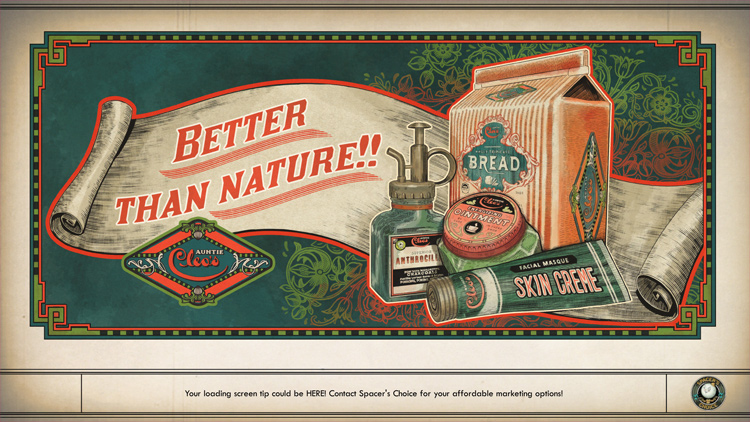
Then there’s The Outer Worlds, where consumerism is deeply ingrained in the game’s culture, as shown in the game’s very meta loading screens. The player encounters items like the ones shown above everywhere, and every NPC seems to be trapped in a corporate-sponsored hellscape, repeating jingles and taglines like scripture. These tropes are widespread, especially in futuristic settings, because they’re believable.
These fictional campaigns work because they tap into public skepticism. They recognize that many people view advertising as manipulative, invasive, and often ridiculous. And by pushing those qualities to their limits, they make space for critique. They show us what happens when branding goes unchecked. For marketers, that’s a useful reflection. It’s a reminder that audiences are smart, self-aware, and often wary. This isn’t to say you should ditch marketing, but it does show that audiences want us to stay in touch with public sentiment and engage more thoughtfully.
Emotional Intelligence in Fictional Campaigns
Fictional campaigns aren’t always outlandish or satirical. Some of them tap into deep emotional resonance. In Mad Men, the famous “carousel” pitch isn’t a real ad, but it’s a masterclass in using nostalgia to sell a product. In this case, that product is a photo projector that becomes a symbol of memory and time.
In the movie Her, fictional ads for tech products feel almost too real. They speak in hushed, intimate tones about connection and loneliness, mirroring both the protagonist’s emotional state and modern branding’s obsession with personalization. In games like Cyberpunk 2077, advertising is designed to feel seamless within the hyper-capitalist dystopia of Night City. The neon posters and holograms you walk past are much more than simple decorations. They build the mood, communicating the culture of a world obsessed with buying and selling sex, violence, and cybernetic body mods. These ads don’t have to sell real products to be compelling, since they convey something truthful about our own cultural surroundings.

Branding Lessons from Fictional Worlds
When we think of memorable fictional brands that have lingered in our minds, they often have one thing in common: Consistency. Duff Beer from The Simpsons, Los Pollos Hermanos from Breaking Bad, and Nuka-Cola from Fallout are all instantly recognizable and perfectly tuned to their worlds. They look and sound like real brands because they follow the same rules as ours. They have logos, slogans, and origin stories. They blend in as part of the environment, but they’re also character-building tools that help to give context to the story.
In video games, branding goes one step further because players can actually interact with ads and products. Sometimes the interaction is critical, using fictional ads to tell a story about the setting. For example, look back on how we talked about The Outer Worlds, which invites players to notice how marketing can swallow an entire society and turn citizens into walking billboards.
Then there’s real products in video games. Product placements are received with varying amounts of success. For example, Death Stranding was both praised and criticized on release for its “shameless” product placement, featuring Monster Energy cans that restore the player character’s stamina in the virtual world while nudging players toward the corner store fridge in the real one. When a brand crosses from fiction into reality like this, it blurs the line between entertainment and commerce in a way traditional ads rarely can. While some consumers will see the brand-media integration as bold or funny, others might see it as an overstep.
Other times, the interaction is designed as a crossover-style event. Fortnite has partnered with all kinds of brands, from LEGO to Balenciaga, on wildly popular collaborations that exist both in-game as skins and wearables, while also having real-life counterparts on store shelves.
The big takeaway is that world-building, consistency, and tone matter just as much in fictional branding as they do in real campaigns.
Why Fiction Does It Better
The context around fictional ads is obviously much different than in reality. In fictional settings, ads are creative assets that are used for worldbuilding and atmosphere. Nobody is actually trying to sell a soda or a sneaker, so there’s room to push the boundaries with something that would be considered risky in our reality. Freedom from ROI, stakeholder interests, and brand guidelines often results in sharper copy, stronger visuals, and bolder or more bluntly truthful statements than we usually see in traditional advertising.
Take The Boys, where the fake mega-corporate brand Vought runs slick, cynical PR campaigns that parody real-life cause marketing. The ads feel painfully accurate, and they hit a nerve because we’ve all seen those same tactics in the wild. Or look at the Barbie movie’s marketing campaign, which walked the line between fictional worldbuilding and real product promotion so skillfully that it became a case study in itself.

These examples stick to your memory not just because they’re clever, but because they highlight something true about advertising. Whether that truth is a brand co-opting empowerment messaging or using nostalgia to sell something forgettable, fictional ads help us see those moves more clearly. That’s even more true when you work in marketing. In fact, an entire site dedicated to housing information on fictional brands, called the Fictional Brand Archive, shows that there really is a lot we can learn about branding from the media we consume.
Perhaps it isn’t too surprising that the most honest look at our industry comes from stories that were never trying to sell anything at all. But by studying the design philosophies behind fictional ads, marketers can see which techniques are most impactful to their audiences: clarity, consistency, depth, and the ability to make an emotional impact.